
Live Blood Analysis Decoded
What It Can and Can’t Tell You (Part 1 of 2)

In recent years, live blood analysis has attracted attention online — not always for the right reasons. Clips, screenshots taken out of context, and untrained overreaching interpretations have contributed to confusion about what can and cannot be meaningfully observed.
At the same time, modern health conversations often swing between two extremes: unquestioning belief and complete dismissal. It follows that live blood analysis has, in some cases, been overclaimed or prematurely rejected.
This two-part series approaches live blood analysis through a terrain-based lens, recognizing the body as an adaptive, self-regulating system and blood as one part of a much larger picture. Written by naturopath and live blood microscopist Caroline Mansfield, these articles clarify the boundaries of responsible use, explain what trained practitioners actually observe in living blood, and emphasize why skill, restraint, and context matter as much as observation itself.
The aim here is not to persuade, alarm, or debunk — but to restore clarity.
By Naturopath, Caroline Mansfield - Dip.Nat Naturopath & Live Blood Microscopist (25+ years clinical practice)
I’ve been working in natural health for over 25 years, and live blood analysis has been a cornerstone of my clinical practice throughout that time. What has shaped my understanding more than anything is working closely with clients and observing how their bodies respond when nutrition, lifestyle, environment, and internal balance are properly supported. This long-term observation has led me to view the body as a self-regulating, adaptive system and to take a terrain-based approach that focuses on supporting the internal environment rather than chasing symptoms.
I first encountered live blood analysis in 1995 in New Zealand during a session with a leading naturopath. Seeing my blood cells alive and actively moving — not as static lab values, but as living tissue responding in real time — left a lasting impression. That experience shaped both my commitment to cellular health and my decision to formally train as a naturopath and live blood microscopist. It also taught an important lesson early on: while live blood analysis can be a powerful observational tool, its value depends entirely on how carefully, skillfully, and responsibly it is used.
What Live Blood Analysis Is — and Why It’s Often Misunderstood
Live blood analysis (LBA) is frequently misunderstood, even within natural health circles. Some people expect it to diagnose disease, while others dismiss it entirely. In reality, it sits somewhere in between and is only useful when its scope and limitations are clearly understood.
LBA involves examining a small drop of fresh capillary blood, viewed live and unstained under dark-field or phase-contrast microscopy. What is observed is not a static snapshot, but a dynamic picture that can change in response to hydration, stress, diet, sleep, and lifestyle factors. It provides qualitative visual insight into patterns at a particular moment in time.
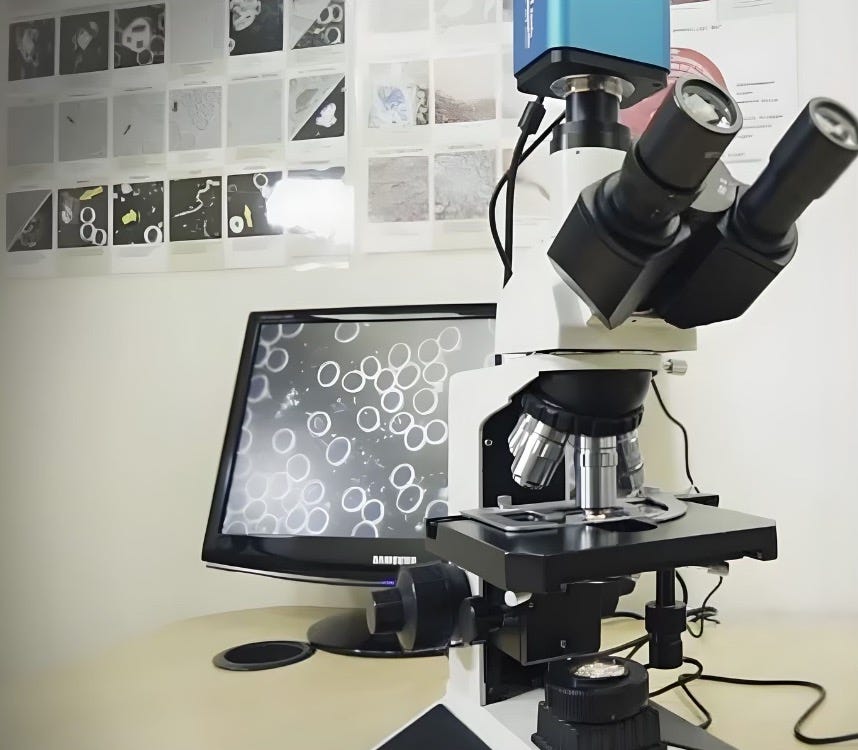
What LBA Can — and Cannot — Tell You
When used appropriately, live blood analysis can offer visual context around:
Circulation quality and blood flow patterns
Red blood cell shape, flexibility, and aggregation
White blood cell activity and responsiveness
Platelet behavior and signs of vascular stress
Plasma dynamics influencing how cells interact
However, it is essential to be clear about what LBA does not do.
Live blood analysis does not measure biological markers. It does not quantify nutrient levels, hormones, immune markers, or toxic load. It cannot diagnose disease and should never be presented as a replacement for conventional blood tests. Its value lies in observation, pattern recognition, and context, not laboratory-grade measurement.
Why Blood Matters — Conceptually
Blood is the link between the external environment and the trillions of cells that make up the human body. Because it circulates continuously and interacts with every tissue, blood offers a unique observational window into systemic influences on cellular health. This is why live, unstained blood has long been observed as a way of gaining insight into physiological balance at a given moment in time — not as a stand-alone diagnostic tool, but as a contextual one.
Blood and the Broader Fluid Terrain
Blood represents only a portion of the body’s total fluids. Roughly 20% of body fluids are contained within the blood, while the remaining 80% exist within the interstitial fluid — the fluid that bathes and surrounds the cells.
From a terrain perspective, this distinction matters. Blood is tightly regulated and must remain within a narrow pH range (approximately 7.35–7.45) to sustain life. When metabolic waste, acidity, or toxic burden increases, the body often buffers and redistributes this load away from the blood, temporarily shifting it into interstitial spaces or fat tissue to protect circulation.
As a result, changes observed in the blood may reflect not only what is present, but how hard the body is working to maintain balance. Live blood analysis can therefore prompt broader questions about tissue terrain, fluid movement, and compensatory mechanisms beyond the bloodstream itself.
Why Training and Practitioner Skill Matter
Live blood analysis requires both precise sampling technique and skilled interpretation. It is surprisingly easy to damage blood cells during collection if technique is poor, which is why comprehensive training is essential. In formal training programs, practitioners spend extensive time learning proper sample collection, repeated observation, and restrained interpretation before working clinically.
A major source of confusion arises when live blood analysis microscopy is conflated with the microscopic examination of materials or product, known as materials microscopy. These are separate disciplines, each requiring different training, preparation methods, and controls. Placing a material or product on a slide and drawing conclusions from what is seen does not fall within the scope live blood analysis training.
Proper analysis of materials, particularly at the micro and nano scale – including specialized microscopy and nano-chemistry - requires entirely different methodological frameworks, controls and levels of expertise. Competency in these fields typically involves many years of formal education and supervised laboratory experience, often spanning undergraduate and postgraduate study, followed by specialized, instrument-specific training.
Unfortunately, it has become increasingly common to see individuals placing products under a microscope, pointing to perceived anomalies and making sweeping claims without the necessary background or methodology. These demonstrations are often mistaken for rigorous research and even praised as such, despite bearing little resemblance to the standards required for genuine materials science or nano-chemical analysis.
Skill, Restraint, and Preventative Context
When it comes to live blood analysis, who you sit in front of matters. A skilled practitioner reads the whole picture — not isolated features — and places observations within clinical context. Findings are shared descriptively rather than diagnostically and may be used to guide preventative conversations around hydration, diet, stress load, digestion, and lifestyle.
A useful analogy is that a microscope is like a musical instrument. In the hands of a beginner, a few notes may be played. In the hands of a trained practitioner, a coherent story can be heard. The difference lies in experience, practice, and restraint.
Blood is never static; it is always responding. Live blood analysis allows part of that conversation to be observed in real time — when used with clarity, context, and care.
In Part 2, we’ll build on this framework and take a guided tour through living blood cells, circulation patterns, plasma dynamics, and terrain-based observations — always within the interpretive boundaries outlined here.
To Your Health,
The Human Consciousness Support Team
For More Information, Check Out Caroline’s Website Linked Here:
https://www.carolinemansfield.com